Description
TLR8: A receptor-type protein tyrosine phosphatase broadly expressed on leukocytes
- Gene Information: Toll-Like Receptor 8 (TLR8) is a protein-coding gene located on chromosome Xp22.2. It belongs to the Toll-like receptor family.
- Protein Expression: TLR8 is a type I transmembrane receptor that consists of three main structural components: an extracellular domain with leucine-rich repeats (LRRs), a transmembrane domain, and a cytoplasmic Toll-interleukin 1 receptor (TIR) domain. Human TLR8 is expressed in monocytes, macrophages, neutrophils, myeloid dendritic cells, and regulatory T (Treg) cells.
- Signaling Pathway: Upon activation by uridine-rich single-stranded RNA, TLR8 dimerizes and recruits MYD88 to form the Myddosome complex. This signaling cascade drives NF-κB and IRF7 activation, leading to pro-inflammatory cytokine and type I interferon production.
- Therapeutic Inhibition: Highly selective TLR8 antagonists can be used for the treatment of autoimmune immune disorders.
Targeting strategy
TLR8
- The exon 3 of mouse Tlr8 gene that encode extracellular domain is replaced by human counterparts in B-hTLR8 mice(C).
- The genomic region of mouse Tlr8 gene that encodes transmembrane domain and cytoplasmic portion are retained. The promoter, 5’UTR and 3’UTR region of the mouse gene are also retained. The TLR8 expression is driven by endogenous mouse Tlr8 promoter, while mouse Tlr8 gene transcription and translation will be disrupted.
- B-hTLR8 mice(C) was obtained by backcrossing the B-hTLR8 mice(110104) with BALB/c mice until siblings at backcross generation 10.
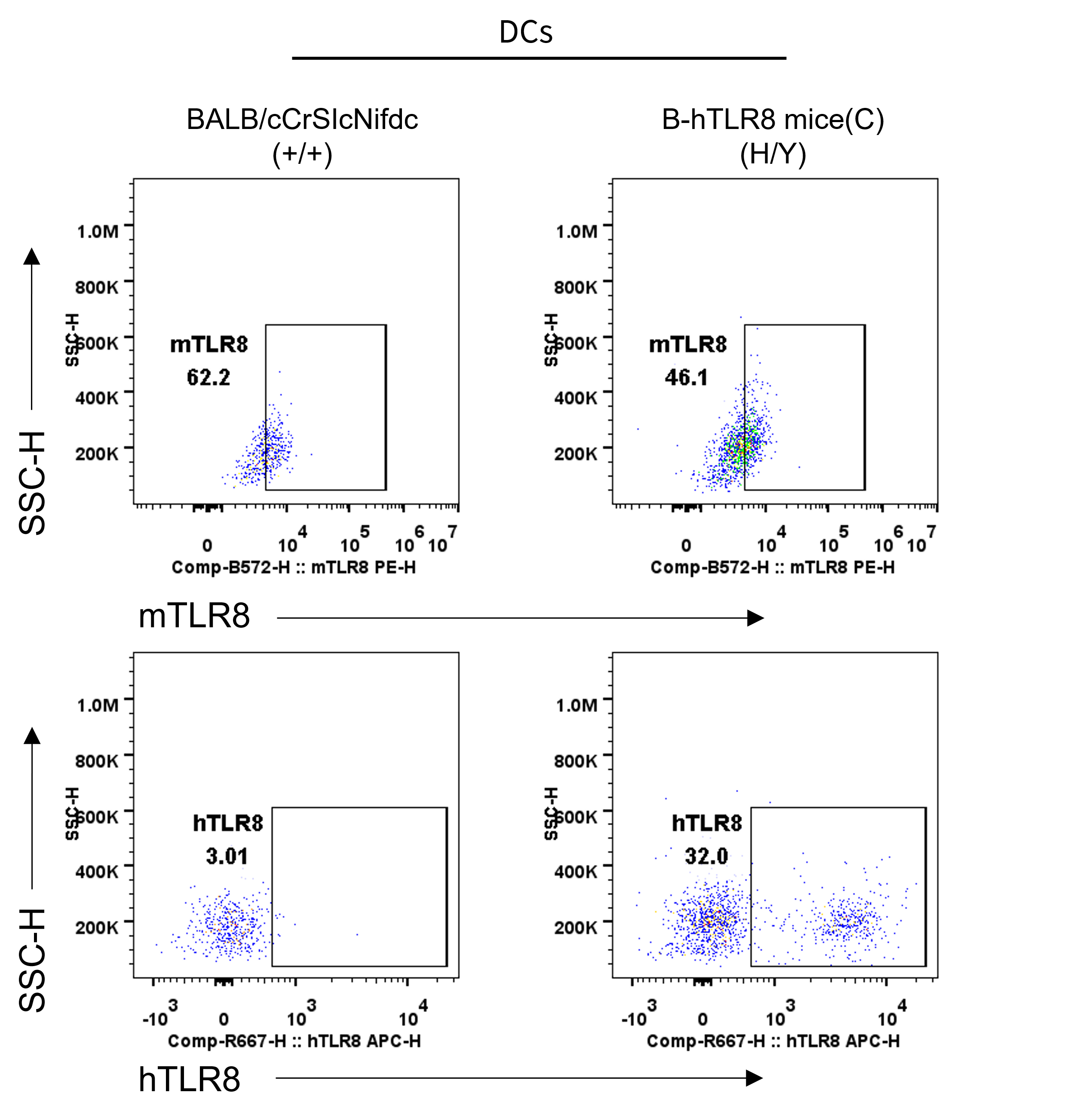
TLR8 Protein Expression Analysis in Spleen
Strain specific TLR8 expression analysis in homozygous B-hTLR8 mice(C) by flow cytometry. Splenocytes were collected from wild-type BALB/cCrSIcNifdc mice (+/+) and homozygous B-hTLR8 mice(C)(H/Y), and analyzed by flow cytometry with anti-mouse TLR8 antibody and anti-human TLR8 antibody. Mouse TLR8 was detectable on DCs of wild-type BALB/cCrSIcNifdc mice and homozygous B-hTLR8 mice(C). Human TLR8 was detectable on DCs of homozygous B-hTLR8 mice(C).
In Vitro Functional Validation
- Signaling pathway of B-hTLR8 mice(C) is complete.
Strain specific mouse IFNγ and TNF-α expression analysis in wild-type BALB/cCrSlcNifdc mice and homozygous humanized B-hTLR8 mice(C) by ELISA. Splenocytes were isolated from wild-type BALB/cCrSlcNifdc mice(+/+) (male, n=2, 9-week-old) , homozygous B-hTLR8 mice(H/Y) (male, n=2, 9-week-old) , and stimulated with TLR8 agonists in vitro for 24 h, then cell supernatants were collected and analyzed by ELISA with species-specific mouse TNF-α ELISA kit and mouse IFN-γ ELISA kit. Mouse IFNγ and TNF-α were increased after responsiveness to the TLR8 agonists(1 μM) in wild-type BALB/cCrSlcNifdc mice and homozygous humanized B-hTLR8(C) mice. Values are expressed as mean ± SEM.
* When publishing results obtained using this animal model, please acknowledge the source as follows: The animal model [B-hTLR8 mice(C)] (Cat# 113431) was purchased from Biocytogen.