
Background
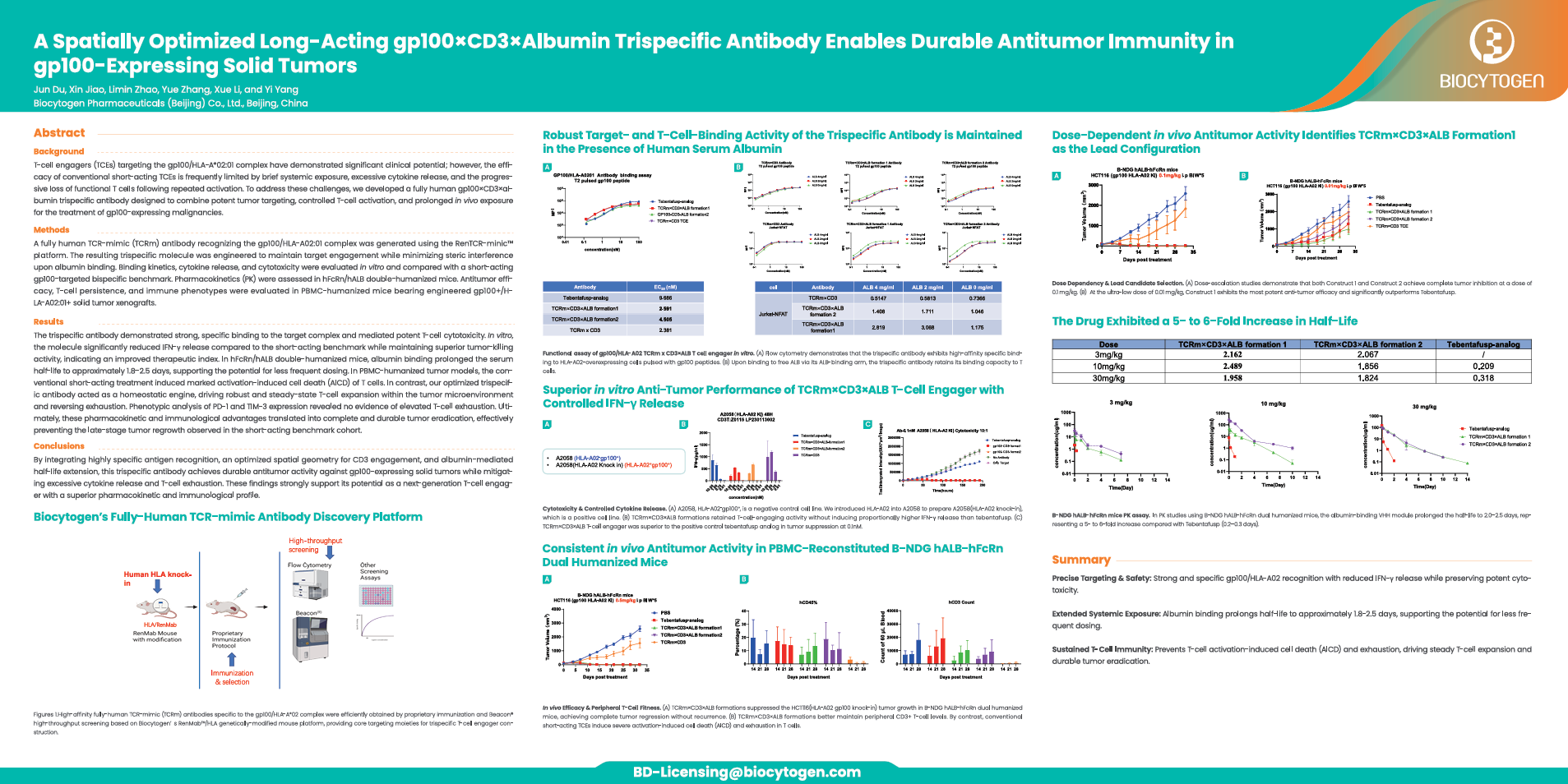
T-cell engagers (TCEs) targeting the complex gp100/HLA-A*02:01 have demonstrated significant clinical potential; however, the efficacy of conventional short-acting TCEs is frequently limited by brief systemic exposure, excessive cytokine release, and the progressive loss of functional T cells following repeated activation. To address these challenges, we developed a fully human gp100xCD3xalbumin trispecific antibody designed to combine potent tumor targeting, controlled T-cell activation, and prolonged in vivo exposure for the treatment of gp100-expressing malignancies.
Methods
A fully human TCR-mimic (TCRm) antibody recognizing the gp100/HLA-A02:01 complex was generated using the RenTCR-mimicTM platform. The resulting trispecific molecule was engineered to maintain target engagement while minimizing steric interference upon albumin binding. Binding kinetics, cytokine release, and cytotoxicity were evaluated in vitro and compared with a short-acting gp100-targeted bispecific benchmark. Pharmacokinetics (PK) were assessed in hFcRn/hALB double-humanized mice. Antitumor efficacy, T-cell persistence, and immune phenotypes were evaluated in PBMC-humanized mice bearing engineered gp100+/H-LA-A02:01+ solid tumor xenografts.
Results
The trispecific antibody demonstrated strong, specific binding to the target complex and mediated potent T-cell cytotoxicity. In vitro, the molecule significantly reduced IFN-γ release compared to the short-acting benchmark while maintaining superior tumor-killing activity, indicating an improved therapeutic index. In hFcRn/hALB double-humanized mice, albumin binding prolonged the serum half-life to approximately 1.8—2.5 days, supporting the potential for less frequent dosing. In PBMC-humanized tumor models, the conventional short-acting treatment induced marked activation-induced cell death (AICD) of T cells. In contrast, our optimized trispecific antibody acted as a homeostatic engine, driving robust and steady-state T-cell expansion within the tumor microenvironment and reversing exhaustion. Phenotypic analysis of PD-1 and TIM-3 expression revealed no evidence of elevated T-cell exhaustion. Ultimately, these pharmacokinetic and immunological advantages translated into complete and durable tumor eradication, effectively preventing the late-stage tumor regrowth observed in the short-acting benchmark cohort.
Conclusions
By integrating highly specific antigen recognition, an optimized spatial geometry for CD3 engagement, and albumin-mediated half-life extension, this trispecific antibody achieves durable antitumor activity against gp100-expressing solid tumors while mitigating excessive cytokine release and T-cell exhaustion. These findings strongly support its potential as a next-generation T-cell engager with a superior pharmacokinetic and immunological profile.