Description
ACVR2B: A Receptor Involved in the Regulation of Muscle Growth
- Gene Information: The transmembrane serine/threonine kinase receptor known as ACVR2B (activin A receptor type IIB) is an essential part of the transforming growth factor-β (TGF-β) superfamily signaling pathway.
- Protein Expression: It is widely expressed in various human tissues, with particularly critical expression levels in tissues closely related to physiological functions, such as muscle, bone, and gonads.
- Signaling Pathway: ActRIIA/ACVR2A and ActRIIB/ACVR2B are TGF-β superfamily transmembrane proteins that serve as type II receptors for activin A, driving essential processes in cellular growth, differentiation, and tissue regeneration.
- Therapeutic Method: ACVR2B inhibitors cover a wide spectrum of potential clinical applications, attributable to muscle’s core involvement in whole-body wellness and disease development. Their leading promising indication targets disorders characterized by muscle depletion. Treatments that boost muscle mass and block tissue atrophy offer tangible therapeutic benefits for patients suffering from muscular dystrophy as well as cachexia triggered by tumors and long-term chronic diseases.
Gene Targeting Strategy
ACVR2B
The exons 1-10 of the mouse Acvr2b gene that encode the whole molecule, including the promoter, 5’UTR, and 3’UTR, were replaced by the exons 1-11 of the human counterparts, including the human promoter, 5’UTR, and human 3’UTR, in B-hACVR2B mice. The human ACVR2B expression is driven by the human ACVR2B promoter, while the mouse Acvr2b gene transcription and translation will be disrupted.
mRNA Expression Analysis
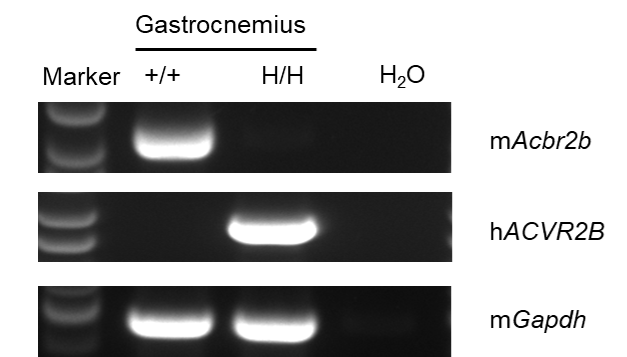
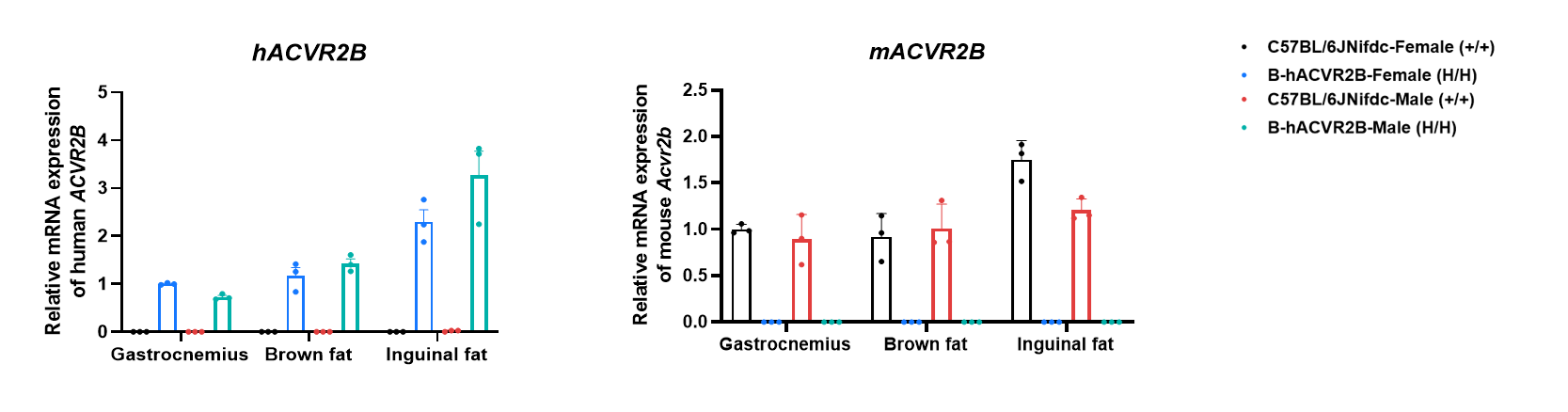
- Mouse Acvr2b mRNA was detectable only in wild-type C57BL/6JNifdc mice.
- Human ACVR2B mRNA was detectable only in homozygous B-hACVR2B mice but not in wild-type mice.
Strain specific analysis of ACVR2B mRNA expression in wild-type C57BL/6JNifdc mice and B-hACVR2B mice by RT-PCR. Gastrocnemius RNA was isolated from wild-type C57BL/6JNifdc mice (+/+) and homozygous B-hACVR2B mice (H/H) (male, 8-week-old), then cDNA libraries were synthesized by reverse transcription, followed by PCR with mouse or human ACVR2B primers. Human ACVR2B mRNA was exclusively detectable in B-hACVR2B mice but not in wild-type mice. Mouse Acvr2b mRNA was exclusively detectable in wild-type mice but not in B-hACVR2B mice. Human sequences were confirmed via Sanger Sequencing.
- Mouse Acvr2b mRNA was detectable only in wild-type C57BL/6JNifdc mice.
- Human ACVR2B mRNA was detectable only in homozygous B-hACVR2B mice but not in wild-type mice.
Species specific analysis of mouse and human ACVR2B gene expression in wild-type C57BL/6JNifdc mice and homozygous B-hACVR2B mice by RT-qPCR. Gastrocnemius, brown fat, and Inguinal fat RNA were collected from wild-type C57BL/6JNifdc mice (+/+) (male and female, n=3, 8-week-old) and homozygous B-hACVR2B mice (H/H) (male and female, n=3, 8-week-old), then cDNA libraries were synthesized by reverse transcription, followed by RT-qPCR with mouse or human ACVR2B primers. Human ACVR2B mRNA was exclusively detectable in B-hACVR2B mice but not in wild-type mice. Mouse Acvr2b mRNA was exclusively detectable in wild-type mice but not in B-hACVR2B mice. Values are expressed as mean ± SEM.
ACVR2B Protein Expression Analysis
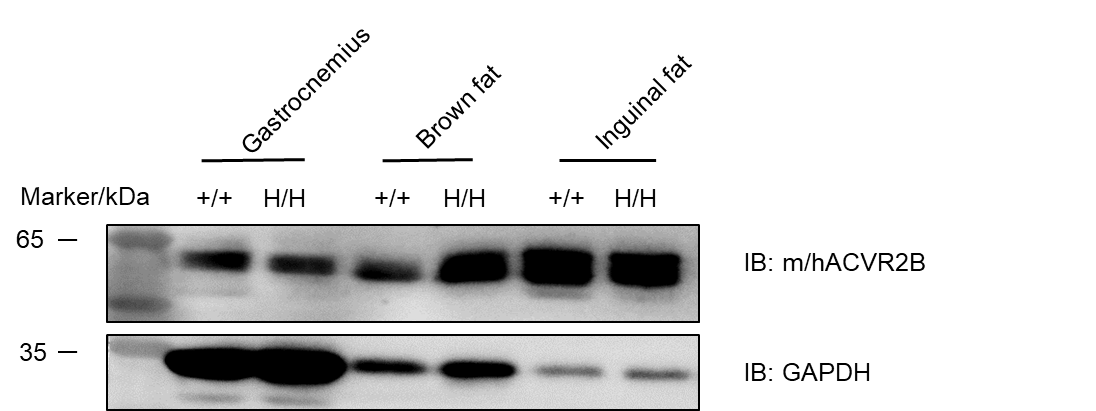
- ACVR2B protein was detectable in homozygous B-hACVR2B mice and wild-type C57BL/6JNifdc mice, as the antibody cross-recognized both human and mouse ACVR2B.
Western blot analysis of ACVR2B protein expression in homozygous B-hACVR2B mice. Various tissue lysates were collected from wild-type C57BL/6JNifdc mice (+/+) and homozygous B-hACVR2B mice (H/H) (male, 8-week-old), and then analyzed by western blot with anti-ACVR2B antibody (Abcam, ab76940). 40 μg total protein was loaded for western blot analysis. ACVR2B protein was detectable in the gastrocnemius, brown fat, and inguinal fat of homozygous B-hACVR2B mice and wild-type C57BL/6JNifdc mice, as the antibody cross-recognized both human and mouse ACVR2B.
The Inhibitory Efficiency of the Nucleic Acid Drugs Against Human ACVR2B
- The human ACVR2B levels in the treatment group were reduced compared to the control group, demonstrating that B-hACVR2B mice provide a powerful preclinical model for in vivo evaluation of human ACVR2B-targeted nucleic acid drugs.

The inhibitory efficiency of the nucleic acid drug against human ACVR2B in homozygous B-hACVR2B mice. B-hACVR2B mice (H/H) were randomly divided into two groups (male, 8-week-old, n=3). The human ACVR2B targeted nucleic acid drug and PBS were administered to the mice individually. The mice were sacrificed on day 14, and the inguinal subcutaneous fat and quadriceps femoris tissues were collected to detect the expression level of human ACVR2B mRNA by qPCR. (A) The schematic diagram of experimental processing. (B) The expression of human ACVR2B mRNA was normalized to the PBS group of each tissue. Values are expressed as mean ± SEM. Significance was determined by two-way ANOVA, *P<0.05, **P<0.01, ***P<0.001.
Note: This siRNA from a client target ACVR2B in adipose and muscle. Data are shared upon the client's approval.
* When publishing results obtained using this animal model, please acknowledge the source as follows: The animal model [B-hACVR2B mice] (Cat# 111351) was purchased from Biocytogen.