
BALB/cCrSlcNifdc-Tnfsf15tm1(TNFSF15)Bcgen Tnfrsf25tm1(TNFRSF25)Bcgen/Bcgen • 113902


Gene targeting strategy for B-hTL1A/hDR3 mice(C).
The exons 1-4 of mouse Tl1a gene that encode extracellular domain were replaced by human counterparts in B-hTL1A/hDR3 mice(C). The genomic region of mouse Tl1a gene that encodes transmembrane domain and cytoplasmic portion was retained. The promoter, 5’UTR and 3’UTR region of the mouse gene were also retained. The TL1A expression was driven by endogenous mouse Tl1a promoter, while mouse Tl1a gene transcription and translation will be disrupted.
The exons 1-10 of mouse DR3 gene that encode the whole molecule (ATG to STOP codon), including promoter, 5’UTR and 3’UTR were replaced by human counterparts in B-hTL1A/hDR3 mice(C). The human DR3 expression was driven by human DR3 promoter, while mouse DR3 gene transcription and translation will be disrupted.

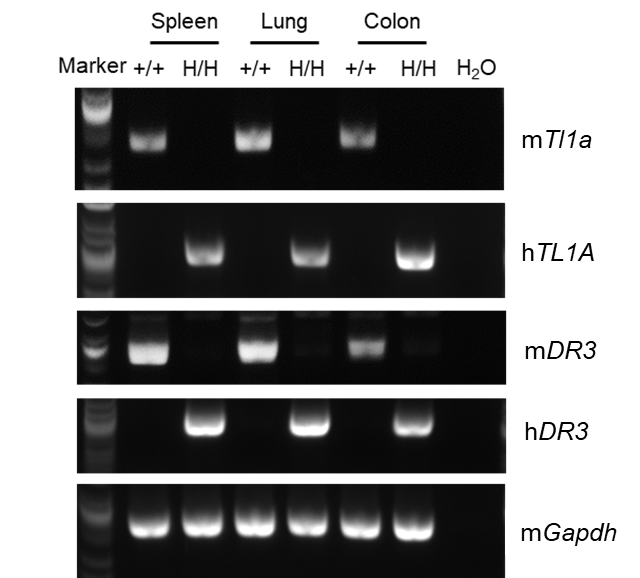
Strain specific analysis of TL1A and DR3 gene expression in wild-type BALB/cCrSlcNifdc mice and homozygous B-hTL1A/hDR3 mice(C) by RT-PCR. Spleen, lung, and colon RNA were isolated from wild-type BALB/cCrSlcNifdc mice (+/+) and homozygous B-hTL1A/hDR3 mice(C) (H/H;H/H). Mouse Tl1a and DR3 mRNA were detectable in wild-type BALB/cCrSlcNifdc mice. Human TL1A and DR3 mRNA were exclusively detectable in homozygous B-hTL1A/hDR3 mice(C) but not in wild-type BALB/cCrSlcNifdc mice.

Soluble TL1A expression analysis in B-hTL1A/hDR3 mice(C) by ELISA. Bone marrow derived dendritic cells (BMDCs) were produced by culturing the bone marrow from wild-type BALB/cCrSlcNifdc mice (+/+) and homozygous B-hTL1A/hDR3 mice(C) (H/H;H/H), which were stimulated with LPS in vitro. After stimulation, the supernatants were collected and the levels of soluble TL1A were measured using a species-specific mouse TL1A ELISA kit (Acrobiosystems, CEA-M259-EN02) and human TL1A ELISA kit (R&D, DY1319-05). Soluble mouse TL1A was exclusively detectable in wild-type BALB/cCrSlcNifdc mice. Soluble human TL1A was exclusively detectable in homozygous B-hTL1A/hDR3 mice(C). Values are expressed as mean ± SEM. ND: not detectable.
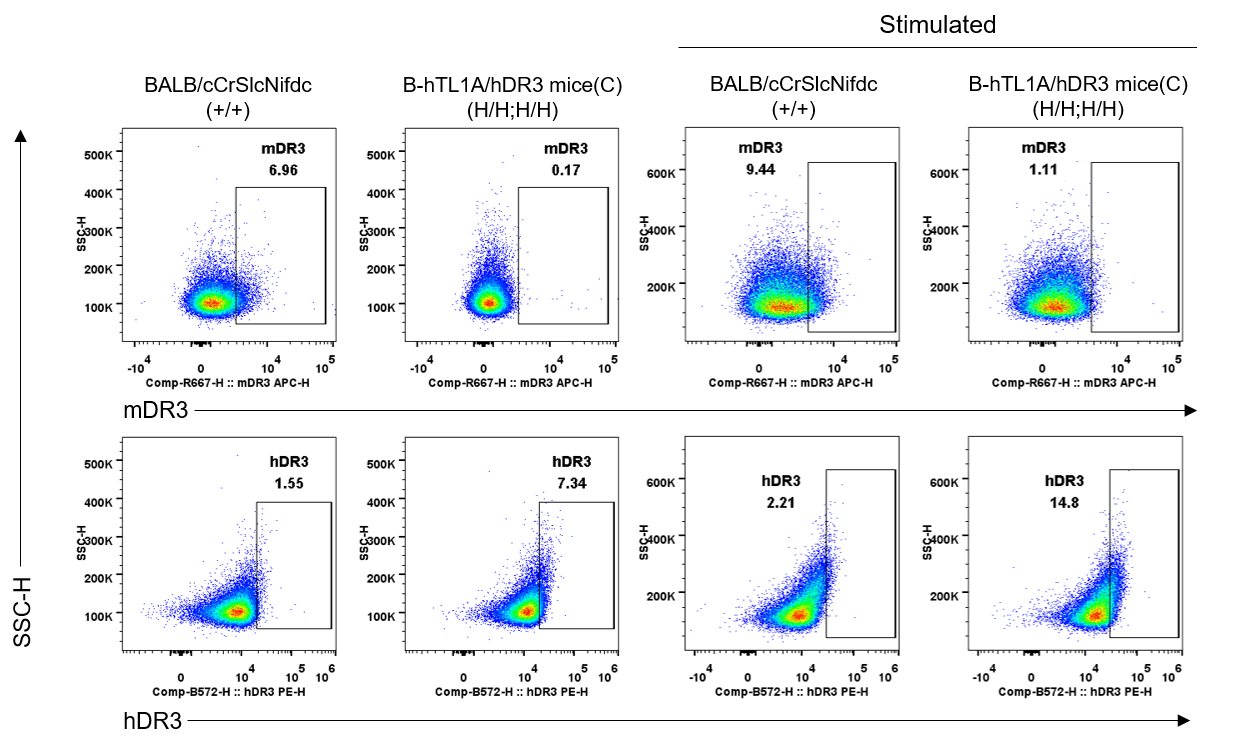
Strain specific DR3 expression analysis in homozygous B-hTL1A/hDR3 mice(C) by flow cytometry. Splenocytes were collected from wild-type BALB/cCrSlcNifdc (+/+) and homozygous B-hTL1A/hDR3 mice(C) (H/H;H/H) stimulated with anti-mouse CD3ε antibody and anti-mouse CD28 antibody in vivo for 24 h, protein expression was analyzed by flow cytometry with species-specific anti-mouse DR3 antibody (BioLegend, 144407) and anti-human DR3 antibody (Biolegend, 307105). Mouse DR3 was detectable on T cells of wild-type BALB/cCrSlcNifdc mice. Human DR3 was detectable on T cells of homozygous B-hTL1A/hDR3 mice(C).
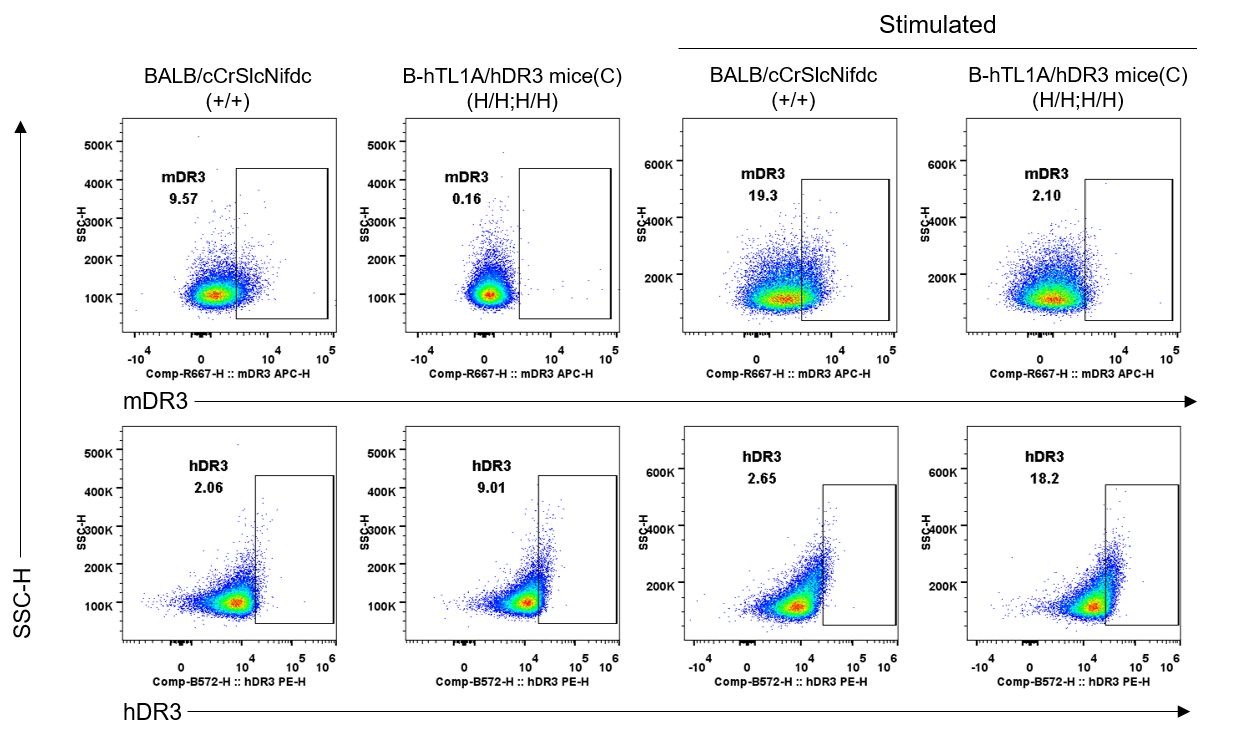
Strain specific DR3 expression analysis in homozygous B-hTL1A/hDR3 mice(C) by flow cytometry. Splenocytes were collected from wild-type BALB/cCrSlcNifdc (+/+) and homozygous B-hTL1A/hDR3 mice(C) (H/H;H/H) stimulated with anti-mouse CD3ε antibody and anti-mouse CD28 antibody in vivo for 24 h, protein expression was analyzed by flow cytometry with species-specific anti-mouse DR3 antibody (BioLegend, 144407) and anti-human DR3 antibody (Biolegend, 307105). Mouse DR3 was detectable on CD4+ T cells of wild-type BALB/cCrSlcNifdc mice. Human DR3 was detectable on CD4+ T cells of homozygous B-hTL1A/hDR3 mice(C).